PitchLoop89 remote
Hardware remote control for PitchLoop89
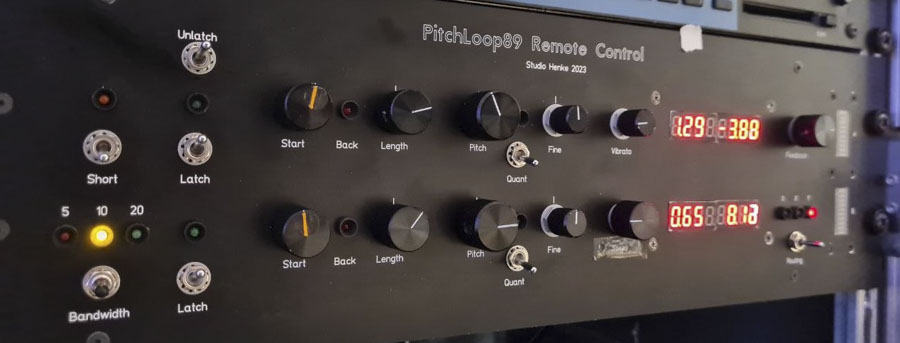
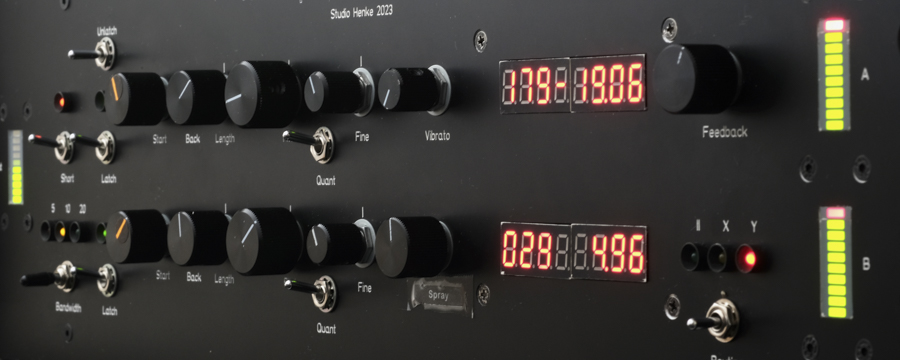
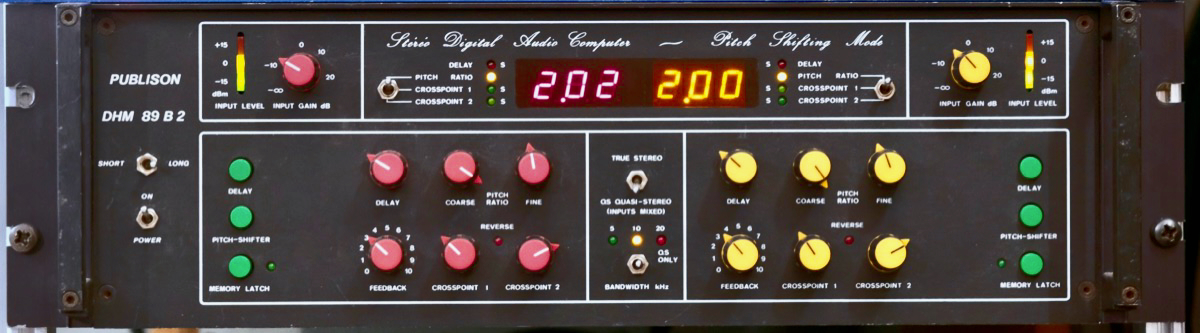
The Publison DHM89-B2, a pitch shifter & looper from 1978 plays an important role for the sound design of the CBM8032AV performances. Unfortunately, the original hardware does not appreciate being carried around anymore. Instead, I built a more contemporary solution: A hardware that fits in the rack where the original unit was before. It controls a variation of my PitchLoop89 effect, which is already modelled after the DHM89. The intention of both the hardware and the software is not to create a 100% replica but an inspired version that is close to the original where required, but departs where desirable.
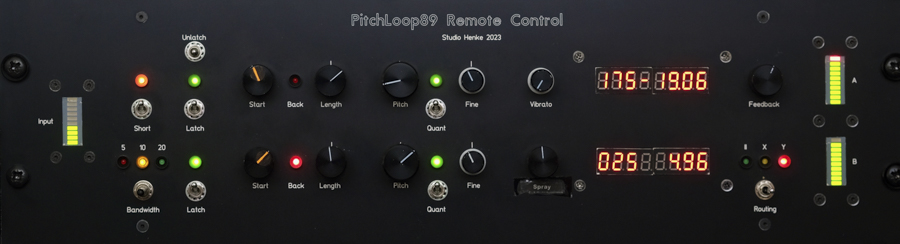
Photo below shows the original 1978 effects unit, photo above the 2022 version.
General Operation and Features
PitchLoop89 Remote allows to control the pitch, and loop / segment length of both stereo channels individually. It allows to freeze ('latch') the currently processed material, to transpose it, and it provides tactile access to other key parameters.
In comparison with the original hardware from 1978 this offers a number of improvements:
Pitch can be quantised to semitones, and is displayed also in semitones and not fractional ratios. Feedback offers cross-feedback and merging, independent of bandwidth settings.
Instead of having a start and end point for the segments, there is a control for position and one for length, where negative length settings imply backwards playback, which - like in the original hardware - is indicated with a red LED.
The modulation LFO is reduced to a single control, acting on both channels in a slightly different way and allowing to quickly set meaningful modulation behaviour. An additional 'Spray' parameter adds random variation to the segment position, expanding the sonic capabilities more into granular territory.
There is a single 'Unlatch' control which allows to momentary feed in new material into the effect and freeze it as soon as the button is released.
Technical Background
The interface is controlled via a Teensy 3.2 microcontroller, and communicates via USB with a Max4Live device running on a Mac mini.
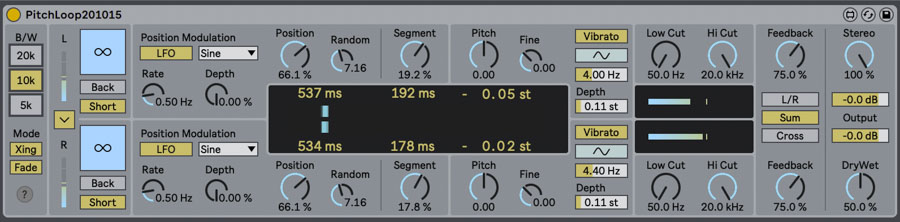
This Max4Live device is a derivation of my PitchLoop89 device (see screenshot above), and the main difference to the normal version is the direct communication with dedicated hardware.
It is planned to some day port the DSP side to a dedicated platform, and to run it all without the need to use an additional computer.
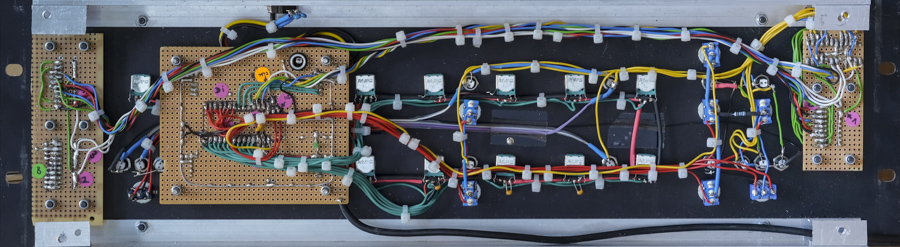
I built the Pitch Loop89 Remote Control in December 2022, using a variation of the PitchLoop89 MaxForLive device, created and published in 2021.